


Page 21 - 伊利沙伯中學舊生會湯國華中學
P. 21
The Magic Box
                                             The Magic Box


                                                                                            5B Wu Tommy

              In the Digital Forest, everyone had a smart box called Little Box, which could solve almost
          anything. Liz was an ordinary villager who loved the box. When she had trouble with math or
          composition, the box gave her instant answers. Soon, she stopped thinking for herself and
          believed life was easy.

              Once, the forest held a handicraft competition. Everyone had to make their own lantern. Liz
          asked the box for a plan, as she always did, and followed it exactly. Her lantern looked perfect,
          but holding it brought her no joy. Her friends’ lanterns were not flawless, but full of warmth and
          personal effort. They received praise, while Liz felt guilty because the work was not really hers.

              She slowly realized she had forgotten how to think by herself. Later, the teachers took all
          the boxes away because the villagers had become too dependent on them. Without the box,
          Liz could hardly write simple sentences or solve easy math questions. It felt like wings that had
          never been used—she was losing her ability to “fly.”
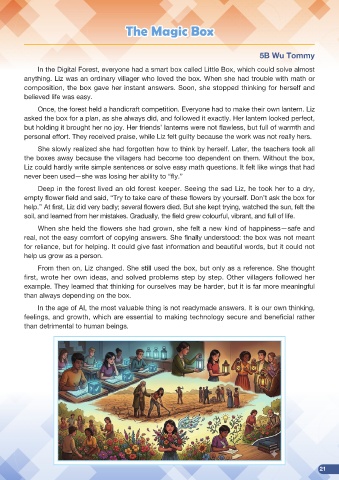
              Deep in the forest lived an old forest keeper. Seeing the sad Liz, he took her to a dry,
          empty flower field and said, “Try to take care of these flowers by yourself. Don’t ask the box for
          help.” At first, Liz did very badly; several flowers died. But she kept trying, watched the sun, felt the
          soil, and learned from her mistakes. Gradually, the field grew colourful, vibrant, and full of life.

              When she held the flowers she had grown, she felt a new kind of happiness—safe and
          real, not the easy comfort of copying answers. She finally understood: the box was not meant
          for reliance, but for helping. It could give fast information and beautiful words, but it could not
          help us grow as a person.

              From then on, Liz changed. She still used the box, but only as a reference. She thought
          first, wrote her own ideas, and solved problems step by step. Other villagers followed her
          example. They learned that thinking for ourselves may be harder, but it is far more meaningful
          than always depending on the box.
              In the age of AI, the most valuable thing is not readymade answers. It is our own thinking,
          feelings, and growth, which are essential to making technology secure and beneficial rather
          than detrimental to human beings.


                                                                                                                 21

