


Page 52 - 皇仁書院(Newsletter)
P. 52
STEAM Education


        Through STEAM education, we aim to help students become aware of the social, economic, environmental, and
        technological implications and show concern for the local environment and society.

        Integrating STEAM in Junior Education

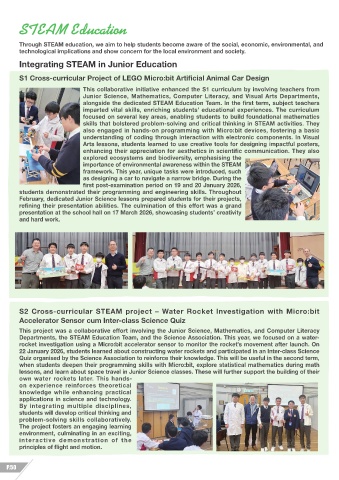
        S1 Cross-curricular Project of LEGO Micro:bit Artificial Animal Car Design

                              This collaborative initiative enhanced the S1 curriculum by involving teachers from
                              Junior Science, Mathematics, Computer Literacy, and Visual Arts Departments,
                              alongside the dedicated STEAM Education Team. In the first term, subject teachers
                              imparted vital skills, enriching students’  educational experiences. The curriculum
                              focused on several key areas, enabling students to build foundational mathematics
                              skills that bolstered problem-solving and critical thinking in STEAM activities. They
                              also engaged in hands-on programming with Micro:bit devices, fostering a basic
                              understanding of coding through interaction with electronic components. In Visual
                              Arts lessons, students learned to use creative tools for designing impactful posters,
                              enhancing their appreciation for aesthetics in scientific communication. They also
                              explored ecosystems and biodiversity, emphasising the
                              importance of environmental awareness within the STEAM
                              framework. This year, unique tasks were introduced, such
                              as designing a car to navigate a narrow bridge. During the
                              first post-examination period on 19 and 20 January 2026,
        students demonstrated their programming and engineering skills. Throughout
        February, dedicated Junior Science lessons prepared students for their projects,
        refining their presentation abilities. The culmination of this effort was a grand
        presentation at the school hall on 17 March 2026, showcasing students’ creativity
        and hard work.


        S2 Cross-curricular STEAM project – Water Rocket Investigation with Micro:bit
        Accelerator Sensor cum Inter-class Science Quiz

        This project was a collaborative effort involving the Junior Science, Mathematics, and Computer Literacy
        Departments, the STEAM Education Team, and the Science Association. This year, we focused on a water-
        rocket investigation using a Micro:bit accelerator sensor to monitor the rocket’ s movement after launch. On
        22 January 2026, students learned about constructing water rockets and participated in an Inter-class Science
        Quiz organised by the Science Association to reinforce their knowledge. This will be useful in the second term,
        when students deepen their programming skills with Micro:bit, explore statistical mathematics during math
        lessons, and learn about space travel in Junior Science classes. These will further support the building of their
        own water rockets later. This hands-
        on experience reinforces theoretical
        knowledge while enhancing practical
        applications in science and technology.
        By integrating multiple disciplines,
        students will develop critical thinking and
        problem-solving skills collaboratively.
        The project fosters an engaging learning
        environment, culminating in an exciting,
        interactive demonstration  of the
        principles of flight and motion.


   P.50

